Gas Forge Operation: Difference between revisions
No edit summary |
No edit summary |
||
| Line 3: | Line 3: | ||
This page covers the detailed startup, tuning, and shutdown procedures for the Housemade Apollo Forge. For an overview of all forges, see [[Gas and Induction forge|Gas and Induction Forge]]. | This page covers the detailed startup, tuning, and shutdown procedures for the Housemade Apollo Forge. For an overview of all forges, see [[Gas and Induction forge|Gas and Induction Forge]]. | ||
'''The wall regulator should NEVER be touched.''' If you suspect the forge is not tuned correctly, follow the tuning procedure below. | '''The wall regulator should NEVER be touched.''' It is preset to approximately 5 PSI. If you suspect it has been adjusted, contact Makerspace leadership. If the forge is not tuned correctly, follow the tuning procedure below. | ||
'''Recommendation:''' For most users, the induction forge is the better choice – it has faster setup, tuning, and cooldown. Use the gas forge only when you specifically need its large interior volume or radiant heat characteristics. | '''Recommendation:''' For most users, the induction forge is the better choice – it has faster setup, tuning, and cooldown. Use the gas forge only when you specifically need its large interior volume or radiant heat characteristics. | ||
| Line 29: | Line 29: | ||
# Open the pre‑regulator valve (move it down, inline with the gas line). | # Open the pre‑regulator valve (move it down, inline with the gas line). | ||
# Open the post‑regulator valve. | # Open the post‑regulator valve. | ||
# Turn on the air supply / fan. '''This can be done any time before the final gas valve is opened, but it must be running before any gas flows.''' It is critical that air is moving before fuel enters the forge. | # Turn on the air supply / fan. '''This can be done any time before the final gas valve is opened, but it must be running before any gas flows.''' It is critical that air is moving before fuel enters the forge. | ||
| Line 42: | Line 41: | ||
Ideally, the forge tuning should not need adjustment. In our experience, however, previous users may still touch the controls. Never assume it is set up correctly. | Ideally, the forge tuning should not need adjustment. In our experience, however, previous users may still touch the controls. Never assume it is set up correctly. | ||
'''The regulator on the wall SHOULD NEVER BE TOUCHED.'''. | '''The regulator on the wall SHOULD NEVER BE TOUCHED.''' It is preset to approximately 5 PSI. | ||
Both gas and air can be adjusted to achieve an ideal burn. For a visual guide, watch the video below: | Both gas and air can be adjusted to achieve an ideal burn. For a visual guide, watch the video below: | ||
Latest revision as of 13:44, 17 May 2026
General Information
This page covers the detailed startup, tuning, and shutdown procedures for the Housemade Apollo Forge. For an overview of all forges, see Gas and Induction Forge.
The wall regulator should NEVER be touched. It is preset to approximately 5 PSI. If you suspect it has been adjusted, contact Makerspace leadership. If the forge is not tuned correctly, follow the tuning procedure below.
Recommendation: For most users, the induction forge is the better choice – it has faster setup, tuning, and cooldown. Use the gas forge only when you specifically need its large interior volume or radiant heat characteristics.
Startup Procedure
Follow these steps in exact order. The air must be moving before gas – this is critical.
Outside
- Propane Tank Setup
-
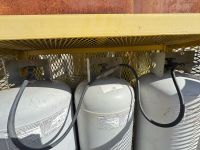 100 lb propane tanks behind the building (connected in series)

- Open the 100 lb propane tanks behind the building (they are connected in series).
Inside
- Interior Valves
-
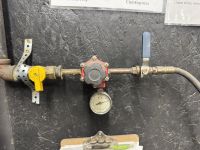 Pre‑regulator and post‑regulator valves on the interior wall
 -
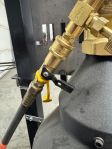 Flexible hose valve (before the quick disconnect)
 -
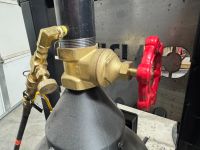 Gas and air mixing valves on the forge


- Open the pre‑regulator valve (move it down, inline with the gas line).
- Open the post‑regulator valve.
- Turn on the air supply / fan. This can be done any time before the final gas valve is opened, but it must be running before any gas flows. It is critical that air is moving before fuel enters the forge.
Lighting
- Prepare a light source – a small piece of lit newspaper inserted into the forge opening works well. Make sure it is actually lit before opening the final valve (the air flow could put it out).
- Open the valve on the flexible hose (the one just before the quick disconnect) last. The forge should ignite immediately.
- Once lit, adjust the gas pressure and air mixture to achieve a neutral flame (blue, with little to no yellow "dragon's breath" exiting the forge openings).
Tuning the Forge
Ideally, the forge tuning should not need adjustment. In our experience, however, previous users may still touch the controls. Never assume it is set up correctly.
The regulator on the wall SHOULD NEVER BE TOUCHED. It is preset to approximately 5 PSI.
Both gas and air can be adjusted to achieve an ideal burn. For a visual guide, watch the video below:
Basic Tuning Tips
- A neutral flame (blue, with little to no yellow "dragon's breath" exiting the forge openings) is most efficient and produces the least scale.
- If the flame is roaring and unstable, reduce the air or gas slightly.
- If the flame is soft and lazy, increase the air or gas.
Shutdown (Cooldown)
- Turn off the valve on the flexible hose inside the building.
- Turn off the pre‑regulator and post‑regulator valves inside the building.
- Turn off the 100 lb propane tanks outside.
- Let the air run for another 30 seconds, then turn it off.
- Perform a fire watch for at least 30 minutes after shutdown.
Troubleshooting
Forge will not light
- Ensure air is flowing before gas (critical)
- Check that the newspaper is actually lit before opening the final valve
- Verify that all valves are open in the correct order
Excessive dragon's breath (flame exiting forge openings)
- Reduce gas pressure or adjust air mixture
- Check that forge doors are properly positioned
Uneven heating
- Ensure the workpiece is centered in the hot spot
- Rotate the workpiece periodically